

Design Philippe Nigro
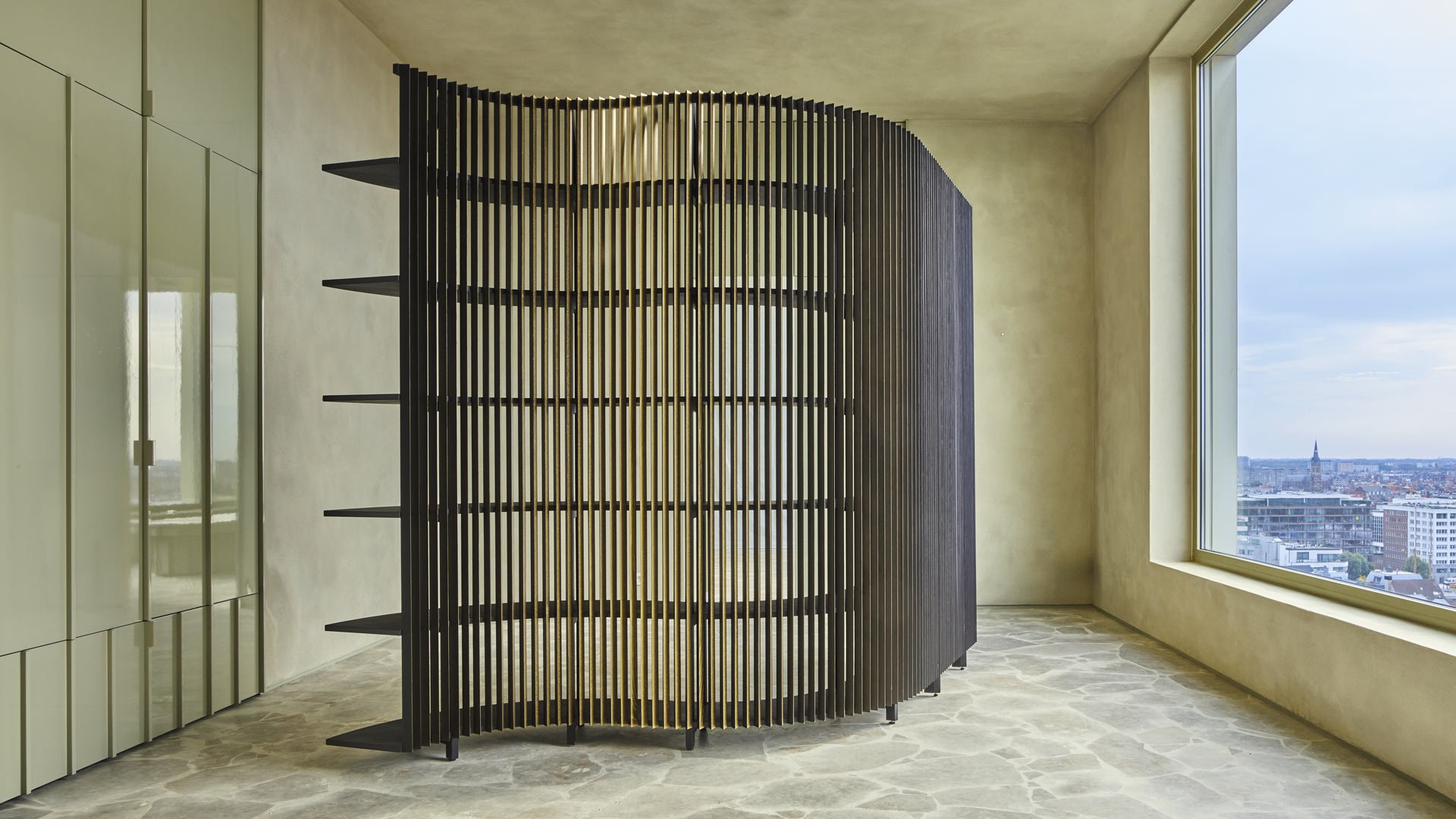
With his Marechiaro collection, designer Philippe Nigro has found a way of sculpting space at will, but softly. Part storage, part perforated panel, Marechiaro plays with light, concealing or revealing by turns that which it contains. As do the rest of the range of small occasional pieces, which share its shuttered aesthetic. Its creator shares its design secrets with us.
How did Marechiaro come into being ?
P. N. From my personal research into the way in which one can structure a space lightly. I like this idea of agility: to design a modular system which enables one to adapt things according to requirements. For example, one might separate the living room from the kitchen, then later the office from the bedroom. It is also evolutive: one absolutely could purchase two modules now, then a third later on. The other guiding principle is the idea of the curve, which catches the light in quite a beautiful way. Aesthetically, it is rather appealing, like a kind of curtain (even if I don’t like curtains) which lends structure, but softly.


P. N. I worked on the project with a small Italian craftsman whom I know well, Alessio Bernardini (A&B Living), who crafts exceptional quality finishes and who has unbelievable expertise in cabinetmaking. And who also takes care of all the production for Ligne Roset. Also, because in terms of expertise, this model calls on those cabinetmaking crafts which are less embedded in the company. But it’s this synergy which is exciting!
Can you describe Marechiaro in design terms ?
P. N. Marechiaro is a shelving system which can be built using three base modules: one flat, one convex and one concave. It comprises one face for storage and another perforated shutter-style face with a multitude of triangular battens in solid wood; each face may be coloured differently. A principle which enables one to play with the way in which the object is perceived in a space, depending on how one moves around it – this, by the way, is all thanks to the bravura and expertise of Alessio.


P. N. But it’s also a system of screens which go around an item, making it possible to create micro-architectures, even in the domestic realm, but in a light manner, so that it can stand on its own and can be moved around. Finally, if one broadens the scope a little, it’s a system which can certainly be used in the open space of an office to create little alcoves, waiting areas, etc. Then we have also worked with Ligne Roset on a version of the system with low tables, bedside tables, etc. based on the screening aesthetic, on the idea of conceal/reveal, allowing light to pass through, etc. It’s different to the system, yet creates an enrichingly consistent range.


